



KNESS at the Ukrainian Investment Congress 2025
05/08/2025
Energy storage system developed and produced by KNESS has been certified for compliance with the ancillary services requirement
14/08/2025Press center
The implementation of standalone energy storage projects and those within a generation facility
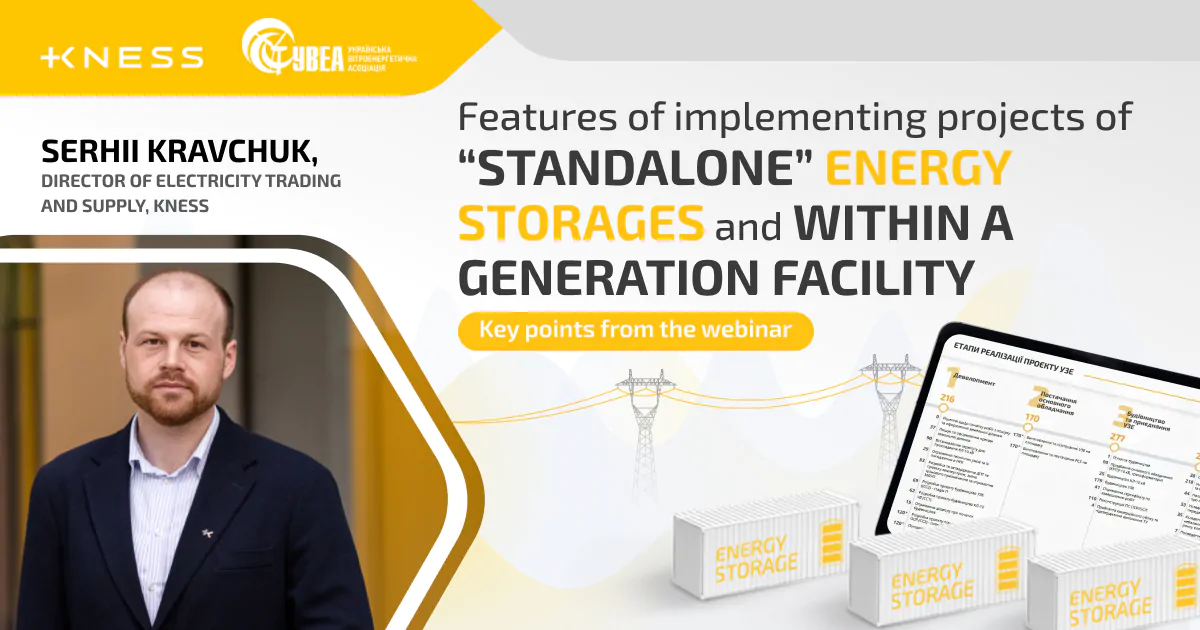
Within the framework of a webinar organized by the Ukrainian Wind Energy Association (UWEA), leading industry experts discussed key aspects of the implementation of energy storage (ESS) projects in Ukraine. The event was the first in a new series dedicated to legal and practical issues related to the ESS operation, which are no longer a technology of the future, but an urgent need for stabilizing the Ukrainian energy system.
One of the key speakers at the webinar was Serhii Kravchuk, Director of Electricity Trading and Supply in KNESS. In his speech, the expert outlined the issues related to the implementation of standalone energy storage projects and those within a generation facility.
Key points from Serhii’s speech:
Legal context: ESS operating models within the producer’s perimeter
The first model is ESS operation within the perimeter of a producer that has a “green tariff” and is part of the Guaranteed Buyer’s Balancing Group. In this option, ESS can be used to balance RES with the aim of saving on imbalance settlement costs. However, investors should carefully calculate the financial model to assess the feasibility of installing ESS for this particular purpose. This is because, at present, the cost of balancing imbalances for RES producers is relatively low. Also, under this model, energy for charging the ESS can only be withdrawn from the facility’s own generating units. At the same time, the electricity fed into the grid must not exceed the installed capacity of the generation facility itself.
The second model is ESS operation within the perimeter of a producer who has a “green tariff” and operates outside the Guaranteed Buyer’s Balancing Group. What is special about this model? To charge the ESS, it is possible to use electricity from own generating facilities or to withdraw electricity from the transmission system operator (TSO) or distribution system operator (DSO) grids. The key technical requirements remain the same as for the previous model — separate commercial metering for ESS and not exceeding the installed capacity.
The third model is ESS operation under market conditions. This option is the most interesting for new projects. This model also allows electricity to be used from both own installations and TSO/DSO grids. A distinctive feature is that no separate license for energy storage is required for such activities; a license for electricity generation is sufficient.
Experience of KNESS: Key stages of ESS project implementation as a “standalone” market participant
The implementation of the ESS project begins with development. This is the initial and most time-consuming stage, which includes searching for and registering land rights, obtaining technical conditions for connection and their approval, developing and approving a detailed territory plan (DTP), a land management project, obtaining urban planning conditions and restrictions, and forming a construction project for the ESS and cable line for connection. The final sub-stage is obtaining a permit to start construction work.
In parallel with the development process, the purchase and supply of basic equipment is being carried out — specifically, energy storage units, power converters, transformers, etc.
Next comes construction and connection to the grid. At this stage, the physical implementation of the project takes place: from preparing the energy infrastructure, laying cable lines, installing and commissioning the main equipment, to setting up commercial metering and obtaining a certificate of construction completion, which is the starting point for licensing.
And the final stage is acquiring market participant status, which transforms the constructed facility into a fully-fledged energy asset.
ESS economic model and market opportunities
Using the example of a 6 MW ESS project with a capacity of 25 MWh, Serhii Kravchuk demonstrated financial modeling of ESS operation in various market segments.
The first model is working on the day-ahead market (DAM) based on price arbitrage — buying energy at night at a low price and selling it during morning/evening peaks at a high price.
The second model is the combined operation of ESS on DAM and the balancing market. This is about increasing margins. Despite the greater technical requirements and certain risks, this approach reduces the payback period, which is extremely attractive to investors.
KNESS expert’s speech confirmed that despite the complexity of ESS projects, they are already economically viable and critically important investments in the future of Ukraine’s energy sector.
We are grateful to the UWEA for creating a platform for sharing experiences. Continuing to share our knowledge to build a sustainable and decentralized energy sector in Ukraine.


