

vc_section]


vc_section]
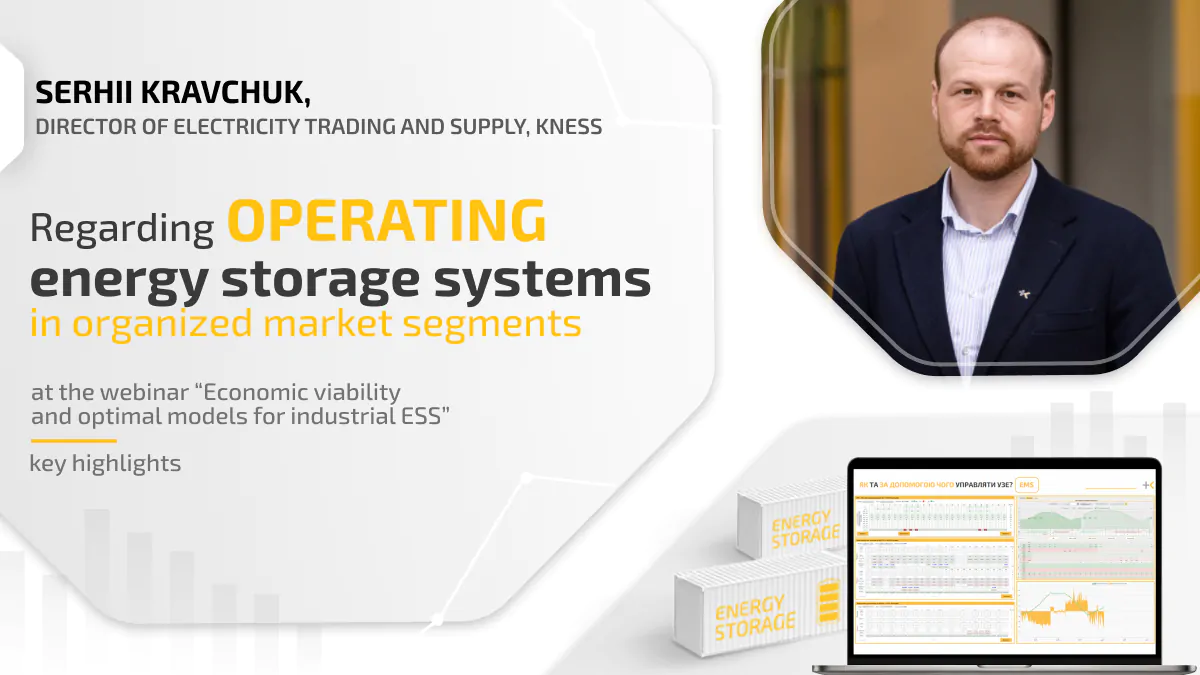
“Before participating in special auctions for the procurement of ancillary services for the transmission system operator, we raised the following hypotheses: can the same energy storage system (ESS) operate in different market segments? That is, to provide ancillary services and, at the same time, due to unused capacity, to purchase and sell electricity in an efficient manner. The profitability of ESS depends on the price volatility in the electricity market. How can such an asset be managed with the greatest economic return?“ These questions were raised by Serhii Kravchuk, Director of Electricity Trading and Supply at KNESS, in his speech at a thematic webinar. The expert’s talk took place at the UWEA online forum: ”Economic feasibility and optimal models for industrial ESS operation.”
As of today, KNESS has practical answers to these questions. We are sharing the main points from Serhii Kravchuk’s speech.
About trends in the energy storage market
The global market continues to see an annual decline in the energy storage cost, which accounts for the bulk of the total project cost. At the same time, the project’s revenue stream is generated from the electricity purchase and sale on organized market segments. The greater the delta in the electricity price between the minimum and maximum values on the market, the better the project’s profitability. An analysis of the price difference on the “day ahead” market from August 2021 to August 2025 shows positive dynamics in terms of the potential profitability of ESS projects.
What equipment configuration should be chosen for trading?
Certainly, the equipment configuration depends on the electricity market segment in which such an electrical installation is planned to be used. The following equipment configurations, which differed in the ratio of power to capacity, namely: 1:1 (i.e., 1 P), 1:2 (0.5 P), 1:3 (0.33 P), and 1:4 (0.25 P) were considered. Spot market price analytics for October 2025 show that the average monthly hourly difference between electricity purchase and sale prices is about UAH 10,000 per MWh. However, it should be understood that the ESS cost with a power/capacity ratio of 1:1 differs significantly from type 0.25 R, with actually the same yield per “transferred” MWh of electricity.
EMS: a tool for effective ESS management
KNESS has developed its own EMS (energy management system) to manage energy storages in various scenarios: for operation on the day-ahead market, intraday market, balancing market, and ancillary services market, as well as for energy transfer to settle imbalances within the balancing group.
KNESS’s EMS interface for monitoring provides access to all key measurement parameters, from the storage charge level to the temperature of the ESS capacity cells.
Among the unique features of our EMS is the option to implement different operating scenarios for different market segments or even for passing certification tests for providing ancillary services for a potential ancillary service provider. For example, this is convenient for energy storage that primarily provides ancillary services and is additionally used in trading. For such a unit, the first task of the EMS automatic mode is to ensure a constant target charge level of the storage in order to have the technical capacity to provide ancillary services, and the second task is to restore capacity with maximum economic effect. Simply put, this is the ability to purchase electricity during “cheap hours” and sell it during “more expensive” hours without interrupting the provision of ancillary services. To determine the optimal market segment in which to buy and sell electricity, it is important to use forecasting models with different forecasting horizons, from 50-minute operational price forecasts to next-day price forecasts.
The system also has an option that enables to buy or sell electricity within the balancing group.
EMS by KNESS is fully integrated with trading platforms via API, allowing operators directly involved in managing such installations to place orders for the electricity purchase/sale without having to log in separately, for example, to XMtrade. At the same time, the system itself monitors the hours when trading has already taken place, for example, on the intraday market. This is quite convenient for conducting operational analytics and short-term price forecasting.
At the same time, the philosophy behind using ESS is about an active business model for ESS in the electricity market, and it is very important to have a reliable management system and a partner to implement such operation.
We would like to thank all webinar participants and UWEA for their effective dialogue, engagement, and expertise exchange on the topic of energy storage.
[/vc_section]


