



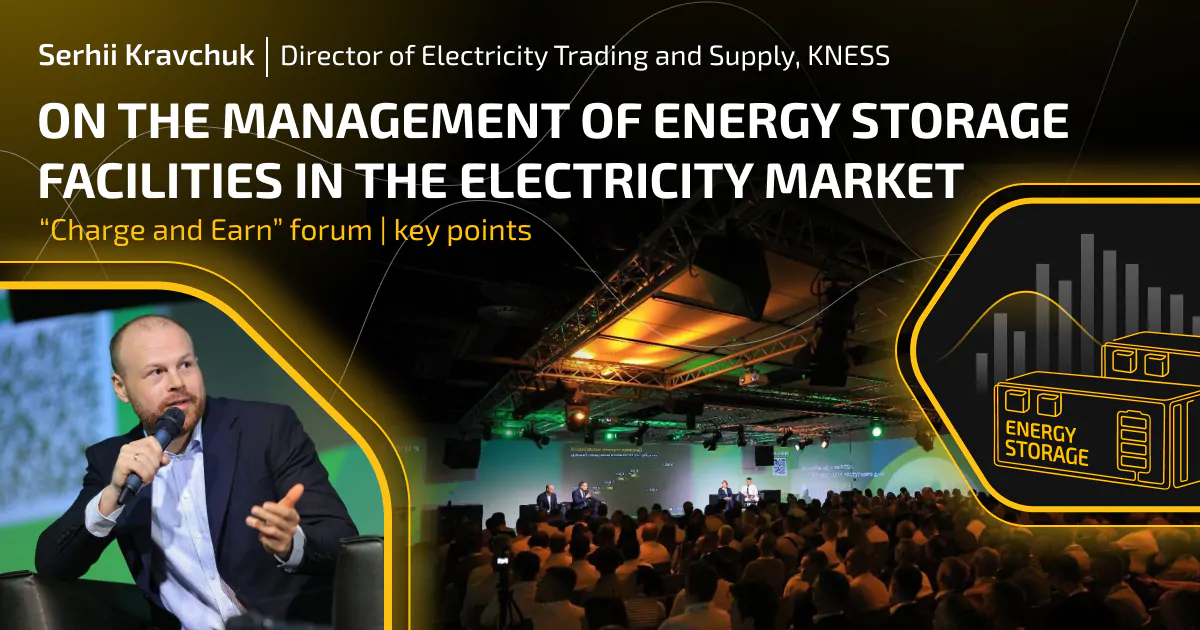
How to manage energy storage systems with maximum efficiency? Serhii Kravchuk, Director of Electricity Trading and Supply in KNESS, outlined this during his speech at the industry forum “Charge and Earn.”
The expert shared KNESS’s practical experience in implementing turnkey ESS projects and discussed optimal business models for their application.
Key takeaways from the expert’s speech: what should be considered when implementing ESS projects?
To evaluate the efficiency of any project, two things should be considered. The first is the cost side, i.e., CAPEX. In the implementation of energy storage system (ESS) projects, the construction and supply of basic equipment is the most significant component. The second is the efficiency of the implemented facility, i.e., revenue generation scenarios.
Key trends: changes in equipment prices for energy storage projects
According to BloombergNEF, since 2022, the price of LFP cells has fallen by almost three times: from $153 to $53 per kilowatt-hour of capacity. And according to relevant assumptions, this downward trend will continue over the next two years. Therefore, there is still a “window” for entering into similar projects for conducting economic activities related to energy storage.
According to analysts, in 2022, the average capacity of a 20-foot container, which is one of the typical industrial energy storage solutions on the market, was 3.44 MWh. As of today, it is already about 5.6-8 MWh. That is, with each year, with the development of technology, the ESS capacity increases without changing the architecture of solutions, which has a positive effect on the CAPEX of ESS projects.
Price trends on the spot electricity market (day-ahead market)
Analysis of price caps on the day-ahead market from 2021 to 2025 shows that the price difference between the nighttime minimum and evening maximum is growing every year: from UAH 2,000 in 2021 to almost UAH 9,400/MWh in 2025. Analysis of the average actual hourly prices on the day-ahead market from 2021 to the present also shows a price spread of about UAH 10,000/MWh, indicating an upward trend that is beneficial for the ESS operation in terms of price arbitrage.
Models for using ESS in the electricity market
ESS as part of an aggregated group
By operating as part of an aggregated group, energy storages’ owners share their risks with the aggregator. In simple terms, an aggregator is a market participant that acts as an intermediary between the dispatcher and the trader, and this is its main value. On the one hand, in terms of ESS application, the aggregator analyzes the technical component — the ESS charge level at any given moment, currents, voltages, power, the temperature at which the ESS is operated, etc. On the other hand, the aggregator focuses on market signals to provide recommendations or independently make decisions on the most profitable scenario for using the entire resource in different market segments at a given moment in time.
As of today, the aggregated group may include consumers, including active ones, electricity producers with a capacity of up to 20 MW, and energy storages without capacity restrictions. As part of the aggregated unit, participants can use their resources to provide ancillary services and balancing services to the transmission system operator. It is also possible to use energy storage systems within the wholesale market segment, where the customer can be a market operator, suppliers, or traders. An example of a sustainable business model could be the conclusion of off-take agreements between aggregators and a supplier and trader within the bilateral contract market. Another possible option is to use ESS to optimize imbalances, but the feasibility of this scenario should be carefully calculated.
The role of ESS as an energy storage system operator
What is the role of an energy storage system operator? First of all, they must monitor the technical resources of the energy storage system: charge level, facility operation planning taking into account further equipment degradation, etc. Other tasks include dispatching, taking price signals into account, and planning the distribution of resources and capacity across different market segments. A separate part of the energy storage system operator’s work is accounting and reporting, providing analytical information on where and with what efficiency a particular resource was used. And also — round-the-clock operational work for the safe operation of equipment.
Financial model of ESS operation “standalone“
Hybrid models involving the use of ESS resources in various market segments are well received by both partners and banks in the context of attracting financing. For example, the model of using ESS in the balancing market and “day ahead” is quite interesting in terms of return on invested capital. The investment attractiveness of such a model can be demonstrated by the example of a standalone ESS project with a capacity of 6 MW and a capacity of 25 MWh. Within the framework of the day-ahead and balancing markets, according to our own mathematical calculations, the profitability of such a project can be twice as high as that of operating in only one market segment. However, such an increase in profitability is possible with high-quality ESS commercial management.
We are grateful to the organizers and forum participants for their interest in the topic of energy storage and the opportunity to exchange experiences. With the development of EES projects, we will be able to change the energy system towards democracy, sustainability, and carbon neutrality.


