



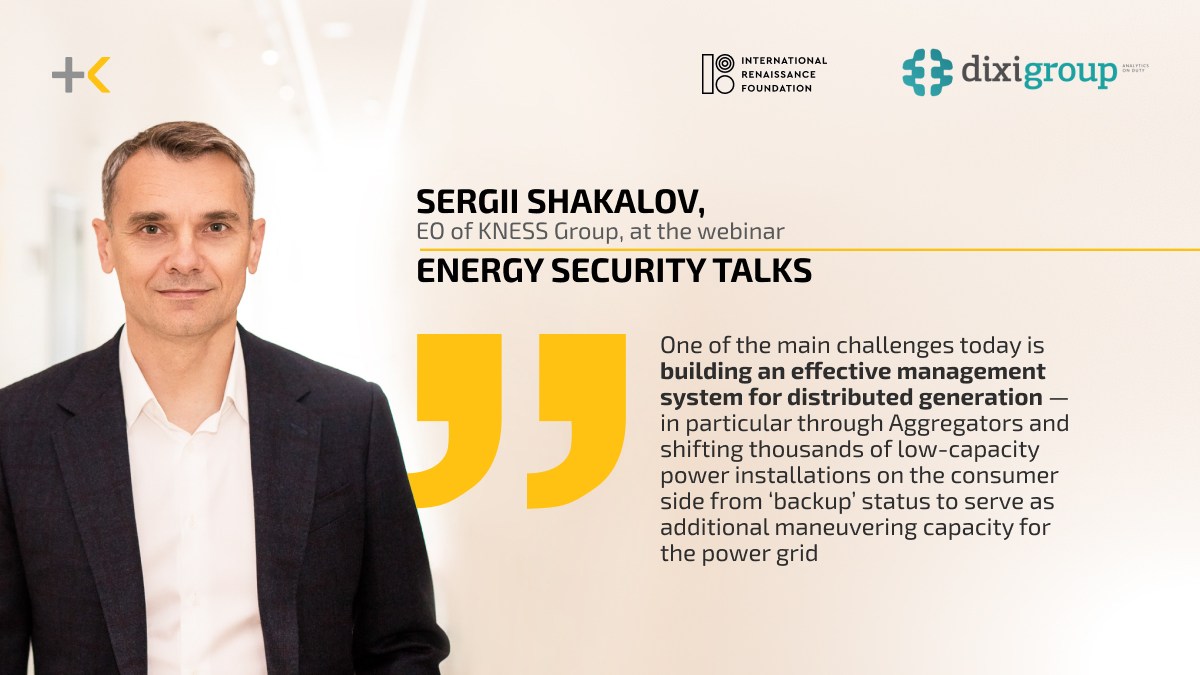
“Technologically, the implementation of solar, wind power plants or energy storage systems is now a well-understood and relatively quick process. One of the main challenges today is building an effective management system for distributed generation – in particular through Aggregators and shifting thousands of low-capacity power installations on the consumer side from ‘backup’ status to serve as additional maneuvering capacity for the power grid,” noted Sergii Shakalov, CEO of KNESS Group, during the webinar Energy Security Talks “Summer Outlooks: Forecast for the Power System’s Operation in Summer”.
The event was organized by DiXi Group with the support of the International Renaissance Foundation as part of the “Strengthening the Resilience of Ukraine’s Energy Sector” project. Industry representatives and key market players discussed the transition to a decentralized energy system.
Sergii Shakalov outlined the technological realities, current and future challenges, as well as the need for long-term planning. We are sharing the key takeaways from the KNESS CEO’s speech:
Distributed generation
The implementation of solar power plants, including on the consumer side, is currently a straightforward and widely adopted solution. Energy storage systems for various applications also remain in high demand. At the same time, wind power generation is a long-term endeavor: Ukraine has experience building wind farms, but these projects are more complex and require a significantly longer planning horizon.
Smart Grid: technology readiness / market unreadiness
The concept of “smart grids” is already technologically clear, but Ukraine is not yet ready for its large-scale implementation. Consumer companies still need time to simply grasp the philosophy and logic behind how a Smart Grid operates. Additionally, there are only a small number of operator companies in the country capable of effectively managing such systems and distributed facilities in general.
It is worth noting that we are currently involved in an initiative to aggregate small generators that have already been imported into Ukraine. The goal is to prepare them technically, remove them from “backup” mode, and make them visible to the power grid. If we succeed in this effort together, the country will gain a certain amount of additional flexible generation capacity within the energy system.
Long-term horizon
The move toward decentralization requires strategic management. The current liberalization of regulatory conditions is already facilitating the flexible and rapid construction of new generation capacity, and now the key focus is on coordinating these processes. Winter will pass, and we will end up with “something.” But it is not entirely clear how to proceed with this “something.” We may face a situation where a large amount of installed generation capacity, under market conditions, turns out to be simply uncompetitive and unnecessary. Therefore, it is precisely a focus on long-term strategy that can transform the chaotic expansion of capacity – particularly on the consumer side – into a stable, balanced, and competitive energy system.


