

vc_section]


vc_section]
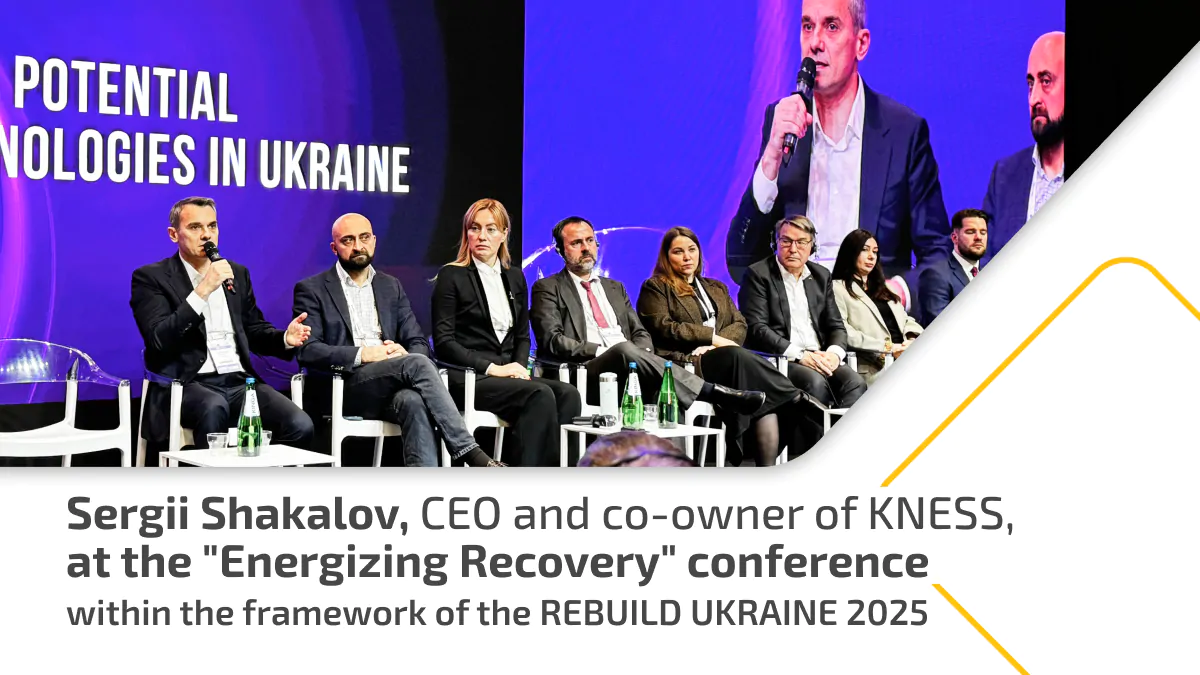
KNESS’s expertise and vision for the development of the energy sector in Ukraine were conveyed at the Rebuild Ukraine 2025 conference.
Sergii Shakalov, CEO of KNESS, has spoken at the international event “Energizing Recovery.” Top stakeholders in the energy sector: high-ranking officials, international partners, technology leaders, and representatives of leading businesses discussed the restoration and modernization of Ukraine’s energy sector. The main focus of the KNESS CEO’s speech was the need to scale up and accelerate the implementation of energy storages in the Ukrainian energy system.
“Energy storage systems, or ESS, are tools that can be used in several configurations: along with generation, as a standalone solution, and along with consumers. For example, KNESS has implemented over 100 MWh of ESS to provide ancillary services for frequency regulation and restoration. At the same time, we use the unused capacity of these installations in the balancing market and for time shifting, which improves their commercialization,” explains Sergii Shakalov.
However, due to its novelty, the potential of an instrument such as ESS is only beginning to unfold.
“We understand which business models are most profitable for using ESS. At the same time, there is still room for research into other scenarios for using this powerful tool. Our modeling shows that using ESS, for example, in conjunction with wind farms can improve project profitability by approximately 4%. The same can be said for solar power plants in Ukraine: combining them with energy storage facilities yields significantly better and more stable results. Ultimately, we could use ESS to load Ukraine’s grids evenly throughout the day, for example, at 90%. After all, there are currently situations where the grids are loaded, say, at 120% in the evening, 80% in the morning, 30% during the day, and 10% at night. Constant, even loading means effective use of existing infrastructure, which helps put off investing in new construction,” believes the CEO of KNESS.
Among other things, Sergii Shakalov outlined a number of reasons that are hindering the development of ESS in Ukraine. These include certain regulatory inconsistencies, issues related to monitoring, work in balancing and aggregated groups, etc. However, in his conclusion, he emphasized that eliminating these shortcomings is only a matter of time, practice, and experience for all participants in the electricity market.
In conclusion, the CEO of KNESS shared his vision for the development of Ukraine’s energy system.
“The transformation of the energy system continues towards decentralization, clustering, and energy independence. Six months ago, industrial ESS solutions in Ukraine were few and far between. Now we are talking about hundreds of MWh of fully installed storage systems. Next year, at least another 1 GWh of ESS capacity will be added. And I am quite confident that within five years, the basic ESS need for Ukraine’s energy system will be met. We believe that, step by step, we will be able to move away from fossil fuels and transition to renewable sources: wind and solar power plants, biogas plants, etc., in combination with energy storages, which have already become an integral part of Ukraine’s energy system,” noted Sergii Shakalov.
We would like to thank the organizers of ReBuild Ukraine 2025, the event partner UWEA, and Andriy Konechenkov, Chairman of the Board of the Ukrainian Wind Energy Association, for moderating the session. We are also grateful to all panel participants for their joint efforts to develop green energy in Ukraine.
[/vc_section]


