



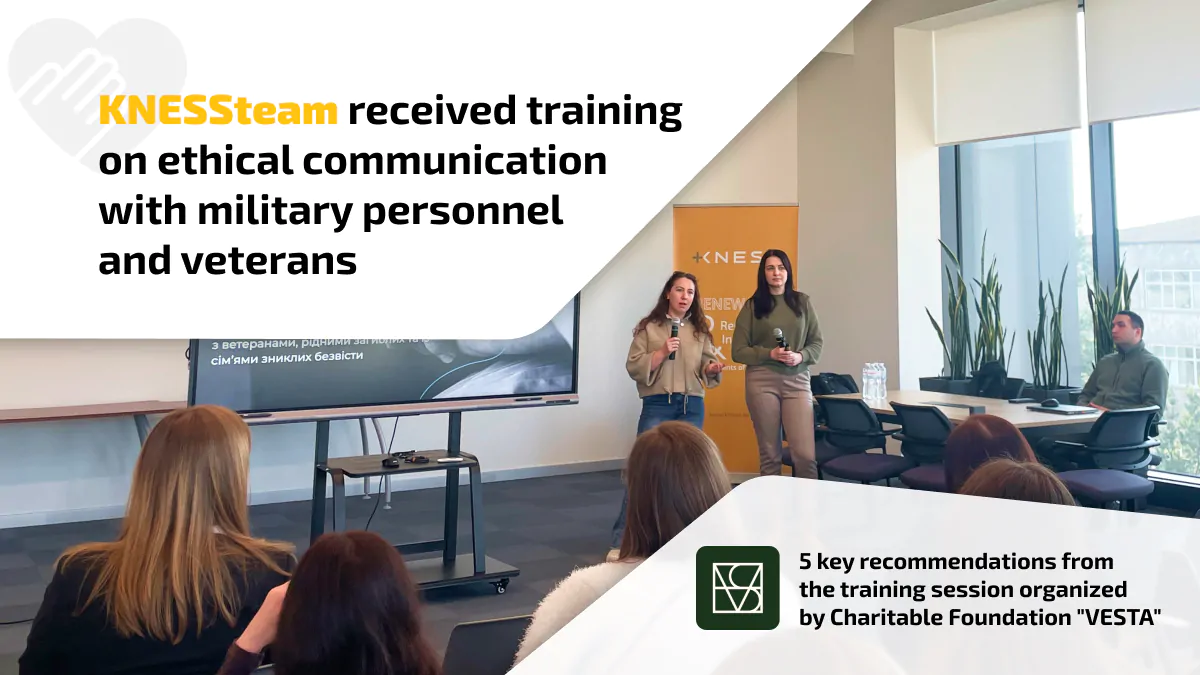
KNESS team received training on ethical communication with veterans from the Charitable Foundation “VESTA” This is part of a comprehensive program to support and assist mobilized employees, veterans, and their families, which KNESS has been implementing for the third consecutive year.
“Preparing and adapting the team to work with colleagues who are defenders is an important part of our corporate veteran program. And such training sessions from specialized organizations are valuable to us in terms of exchanging knowledge and experience, analyzing practical situations that may arise in professional or personal communication, and in daily team interactions,” comments Mariana Hulchak, a Specialist in Supporting Veterans and Their Families.
Expert recommendations on the topic were shared by Olha Pronina, Psychologist of the Mobile Support Service at CF “VESTA”, and Anna Boyko, Coordinator and Social Worker at CF “VESTA”.
Key expert tips shared during the training
-
Respect is the foundation of interaction
All military personnel and veterans deserve respect for defending our country, regardless of the type of their service and the consequences this experience may have had.
Therefore, when interacting with military personnel:
- remember the value of their contribution
- treat their experiences with gratitude and respect
- communicate as equals, without pity
- avoid excessive heroization – first and foremost, you are speaking to a person with their own unique experience
-
Flexibility and openness in communication
Military experience can cause physical, psychological, and behavioral changes that affect a person’s quality of life: physical pain, sleep disturbances, irritability, forgetfulness, increased tension and vigilance, sudden mood swings, intrusive thoughts, and reliving traumatic events.
Approach this with understanding and empathy:
- ask how they are doing and feeling
- minimize sudden loud noises, flashes, and unexpected touch
- behave in a predictable and open manner
- offer your help
- be flexible in communication: repeat important information and share it in different formats so it can be revisited at any time
Remember the underlying causes of these conditions. Do not blame anyone and do not take it personally. Learn about psychological approaches and techniques that can help improve the emotional state in different situations.
-
Communicate but be tactful
Replace certain phrases that may be perceived negatively.
Avoid questions such as: “When will the war end?”, “Have you lost fellow soldiers?”, “Have you killed anyone?”, “Did you enlist voluntarily or were you mobilized?”, “How much did you earn / what payments do you receive?”.
Instead, it’s better to ask: “How are you? How are you feeling?”, “Are there any needs in your unit that we could help with?”, “How can I help / be useful?”, “How can I support you?”
Some phrases can also be triggering, such as “I understand you,” since civilians cannot truly understand a veteran’s experience. It’s better to rephrase it as: “It’s hard to imagine what you’ve been through.” To offer support at the end of a conversation, avoid phrases like “Everything will be fine” or “Stay strong!” Instead, say: “I’m looking forward to your return,” “I’m here for you, reach out if you need anything.”
Keep in mind: money, politics, and religion are topics that can provoke conflict in any community, so it’s best to avoid them.
-
Sincerity, trust, and acceptance
Be an active listener if a veteran or service member wants to share their experiences or stories with you! If you are not ready to listen, say so directly and honestly and explain the reason. Offer another time or context for the conversation.
-
Offering help and support
Before offering help or showing care and attention to a military person, express your intention and motivation using “I-statements” or ask whether your help is needed:
“I would like to treat you as a sign of gratitude for your service, would you be okay with that?”
“I can help you go up the stairs, would you mind?”
“Do you need any help?”
“May I help you? Please let me know the best way to do so without causing any discomfort.”
Stay connected with veteran organizations and communities, such as CF “VESTA,” to be better prepared for different life situations and to have access to professional contacts in cases that may be beyond your ability to handle on your own.
Step by step, forming KNESS environment grounded in trust, mutual respect, and support. With openness and gratitude toward our Defenders, who are an important part of the KNESSteam.
We are grateful to CF “VESTA” for the valuable insights and the team training!


