



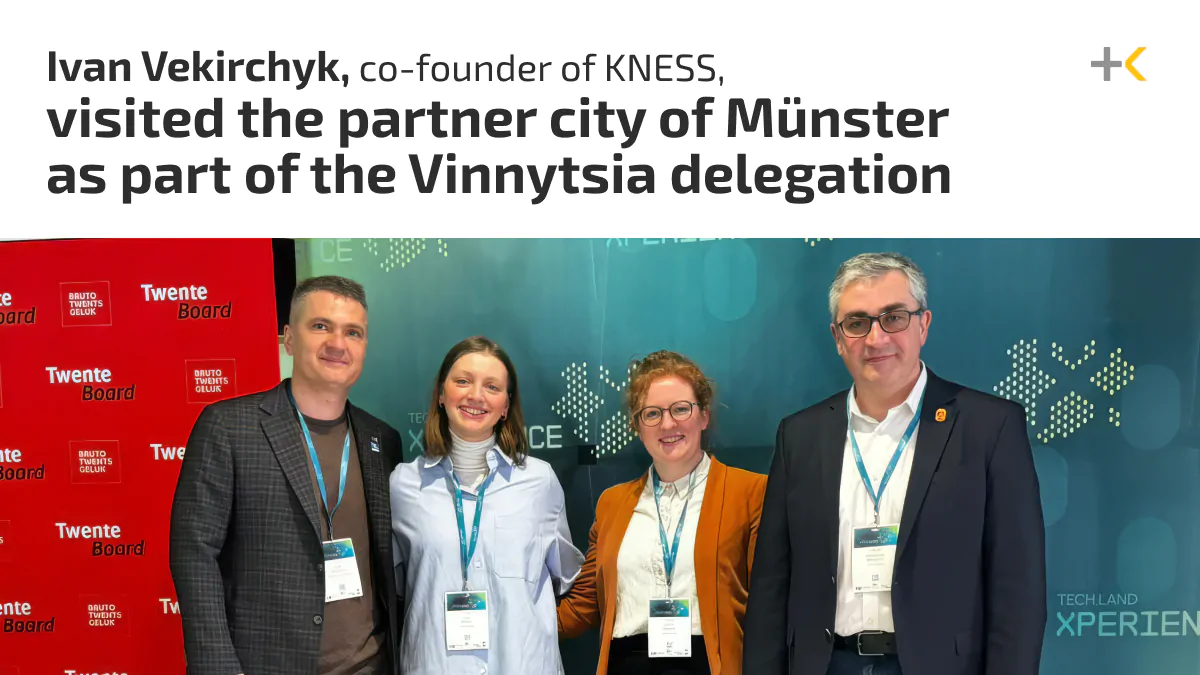
Ivan Vekirchyk, co-founder of KNESS, recently visited the partner city of Münster, Germany, as part of a delegation from Vinnytsia. The delegation attended the international exhibition and conference TECH.LAND and visited the leading technology centers Fraunhofer FFB and MEET. They also made a separate visit to the Arnhem CleanTech Park innovation hub in the Netherlands. In this overview, we share Ivan Vekirchyk’s key insights and findings from the trip.
TECH.LAND International Exhibition and Conference (Münster)
This is one of the key events in the fields of technology and innovation, bringing together scientists, business leaders, startup founders, government officials, and other stakeholders. The main thematic focus of the discussions was the decarbonization of the economy, the development of hydrogen infrastructure, energy storage systems (ESS), digitalization, artificial intelligence, and smart grid management. The event featured panel discussions, startup presentations, and a series of networking sessions. This format allowed participants not only to discuss trends but also to directly establish connections with technology developers and potential partners.
“The event served as a powerful platform for discussing pressing issues and reviewing innovations. Above all, it is important for us to learn from others’ experiences in order to gain a fresh perspective on the development of our own energy solutions ecosystem. We value the exchange of knowledge, as it strengthens our ability to implement smart energy infrastructure that will contribute to sustainable development both in Ukraine and in partner countries,” – noted Ivan Vekirchyk.
A Tour of Germany’s Research Centers: Fraunhofer FFB and MEET
Both research centers specialize in the development of energy storage technologies.
- Fraunhofer FFB is a research institute dedicated to the sustainable production of battery cells. The institute’s activities cover the entire cycle: from technology development and production process optimization to certification, recycling, and specialized training. The center serves as a bridge between science, research, and industry. This approach allows specialized companies to utilize the latest, already developed and tested technological components at their facilities, minimizing risks before entering the global market. In the future, Fraunhofer FFB will work on transitioning new battery concepts from the development stage (TRL 5–6) to full-scale series production (TRL 8–9).
- The Münster Electrochemical Energy Technology (MEET) Battery Research Center at the University of Münster is one of Germany’s leading battery research centers. MEET’s activities encompass both the further refinement of market-leading lithium-ion technology and the development of other battery technologies, including innovative approaches to solid-state batteries. In collaboration with a network of partners, MEET researchers conduct studies aimed at increasing energy density, extending service life, ensuring maximum safety, improving environmental sustainability, and minimizing the cost of current and future energy storage systems. The center is a high-tech facility equipped with robotic systems, specialized microscopes, and other advanced equipment. Such a robust research infrastructure enables scientists to develop not only a better understanding of the battery cell itself but also the foundation for efficient and cost-effective battery cell production.
Arnhem CleanTech Park Innovation Hub (Netherlands)
This unique 90-hectare innovation park serves as a hub for clean technology development. Cleantech Park Arnhem is a project by Schipper Bosch. Here, companies are actively working on products, services, and processes that reduce environmental impact. There are four key areas of focus: energy, transportation, smart material reuse, and human capital development. The park is also unique in that startups and companies have the opportunity to test technologies and solutions within a fairly optimized timeframe. For example, companies are testing hydrogen solutions and “flow” batteries – an eco-friendly alternative to lithium batteries that does not require scarce metals.
“The visit to Arnhem CleanTech Park and research centers in Germany provided a good example of collaboration and an approach to fostering innovation. This experience was truly valuable, as it helps us better navigate global European trends in the energy sector,” – summarized Ivan Vekirchyk.


