



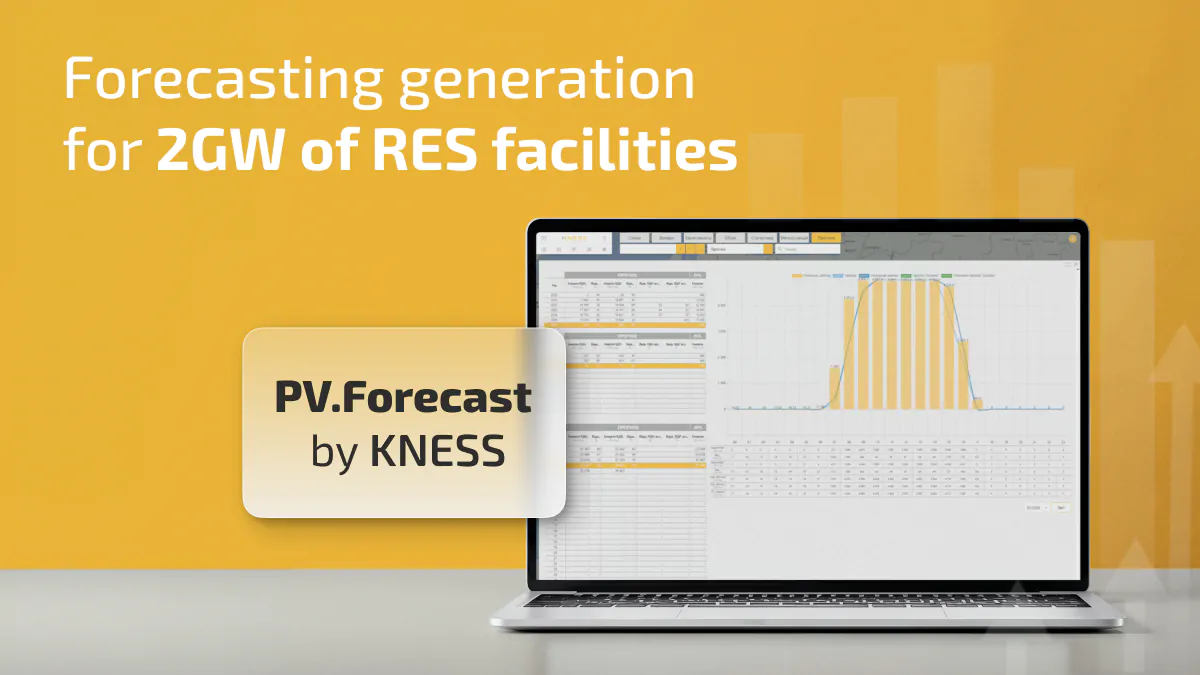
How does KNESS make generation from renewable sources foreseeable?
In 2016, when the first projects of the new electricity market model appeared in Ukraine, KNESS team was already writing the first lines of code for its own RES generation forecasting system — PV.Forecast.
Today, 10 years later, PV.Forecast is an entire ecosystem that forecasts generation for more than 200 energy facilities with a total capacity of about 2 GW. The software complex is also adapted to forecast a large number of low-power generation facilities, in particular, household solar power plants, to reduce imbalances among universal service providers.
Currently, our software complex is one of the most accurate not only on the Ukrainian market, but also on the foreign market. How did we achieve such results? KNESS team is constantly upgrading the system and improving the accuracy of forecast data. As a result, over the past three years, the weighted average error has decreased by 7%.
“Every percentage is the result of thousands of hours of ‘training’ artificial intelligence algorithms. By expanding the historical data base and improving the AI architecture, we have taught the PV.Forecast system to see ‘subtle’ patterns in the operation of various renewable energy facilities. And we continue to improve the accuracy of forecasts by testing new methods and approaches,” notes Maksym Zathey, Head of the Electricity Forecasting Department in KNESS.
We are constantly working to ensure the effectiveness of our solutions, so we encourage you to experience it. RES electricity producers can verify the accuracy of our system’s forecasts by taking advantage of a free trial period: https://trading.kness.energy/forma/


