



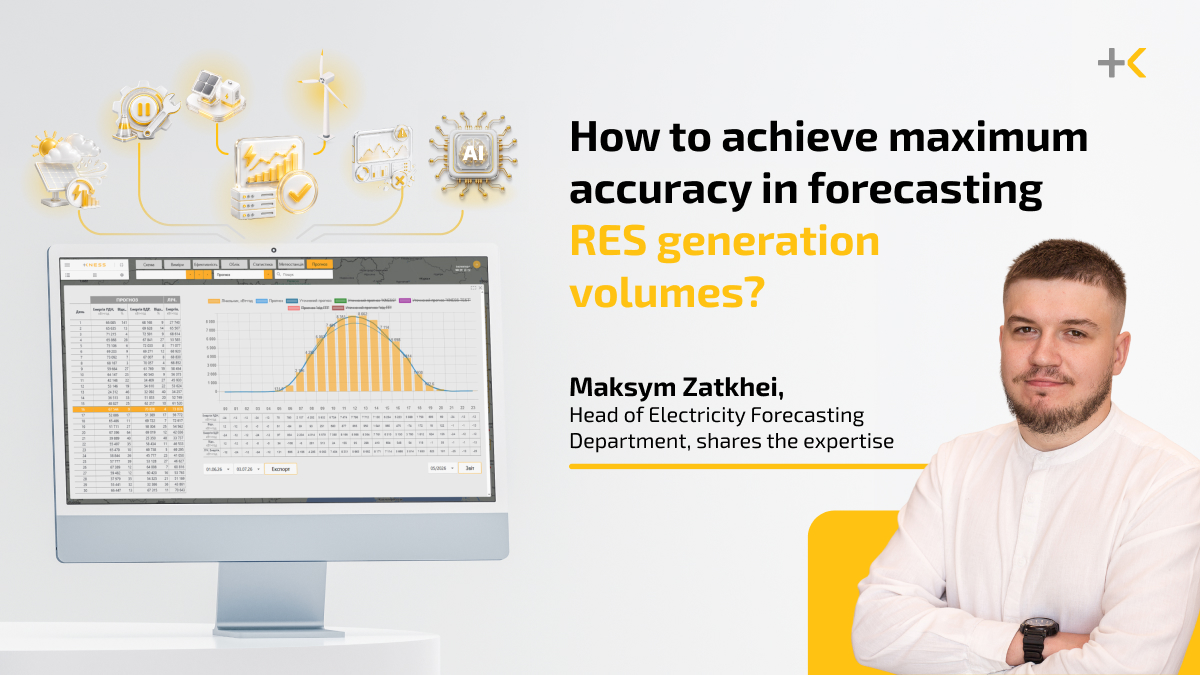
How to achieve maximum accuracy in forecasting RES generation volumes?
“Take into account all relevant input data that could affect electricity generation from renewable sources.” — shares Maksym Zatkhei, Head of Electricity Forecasting Department in KNESS
To collect, prepare, and process data, KNESS forecasting team uses PV.Forecast: a software solution developed in-house that is based on neural networks as well as mathematical and statistical models. This system makes predictions using a large body of information. However, the key factor in its accuracy — and its main advantage — is the high-quality selection, analysis, and validation of this data. After all, it is this data that the neural network uses to train and make more accurate forecasts.
What data is used to create the forecast?
PV.Forecast operates in a continuous cycle of analyzing the following information:
- Technical data on the facility: installed capacity, type and tilt angle of panels/turbines, orientation, etc.
- Data on the facility’s actual electricity output — in real time and over previous periods
- Weather forecast data: air temperature, wind speed and direction in the region, etc.
- Satellite data on cloud cover and insolation
- Other factors: risks of outages, maintenance needs, etc.
- General statistical data obtained by sampling facilities with similar characteristics.
This information is aggregated within the system from various sources, each of which has its own strengths. Some are better at predicting short-term changes in cloud cover, while others are better at forecasting temperature scenarios or wind patterns. PV.Forecast does not simply collect these forecasts; it analyzes their quality, compares them with one another, and combines them in a way that provides the best results for a specific renewable energy facility.
What data is used for “training” PV.Forecast?
For “training,” the system selects only accurate, relevant, and complete information that could potentially influence the “behavior” of a specific facility. It identifies patterns in the facility’s “historical” operational data. In other words, if a specific parameter has previously influenced the generation profile, the system will take this correlation into account in its new forecasts.
At the same time, the system filters out or marks separately any data that could distort the model’s training, such as:
- emergency or unscheduled outages
- network constraints
- service interruptions or maintenance
- incorrect or incomplete telemetry data
“With this approach, the model is trained on meaningful information rather than “noise.” And with each new forecast, the system gains a better understanding of the individual facility’s “behavior” leading to more accurate results” explains Maksym Zatkhei.
What data is used to replace retrospective information for new facilities?
For newly constructed renewable energy generation facilities that lack historical or “retrospective” data, the approach is slightly different.
The lack of historical data is a common issue for new stations, and PV.Forecast has a well-defined approach to addressing it. Retrospective data is replaced with statistical samples:
- typical generation profiles, based on data collected from facilities with similar characteristics
- climatological and satellite data covering a multi-year period for a given location
- physical models that do not require retrospective data.
“We forecast generation for over 300 power facilities with a total capacity of about 2 GW, using PV.Forecast. The sheer number and variety of these facilities across Ukraine allow us to build a high-quality sample dataset ” notes the forecasting expert.
Improving the system to maximize forecast accuracy
PV.Forecast by KNESS is one of the most accurate systems for forecasting solar power generation in Ukraine and abroad.
The weighted average annual error for a new plant is approximately 18–20% for a day ahead solar power generation forecasts. With a further refinement of the forecast, the error can be reduced to 9–12%. And every year the system is used, forecast accuracy improves as the system is trained.
“We are constantly working to improve PV.Forecast. We have a separate team of programmers and testers dedicated solely to developing new neural networks and mechanisms aimed at increasing the forecast accuracy. This is how we manage to reduce the forecasting error for renewable energy facilities every year,” concludes Maksym Zatkhei.
Test the accuracy of PV.Forecast’s estimates with a free trial. Simply fill out the form via the link: https://trading.kness.energy/en/form/


