




KNESS has implemented one more project in Latvia
06/10/2023
The Minister of Climate and Energy of the Republic of Latvia has visited the solar power plant SIA “SP Ludza”
12/10/2023Press center
Expert review: Active Consumers and Self-production Mechanism
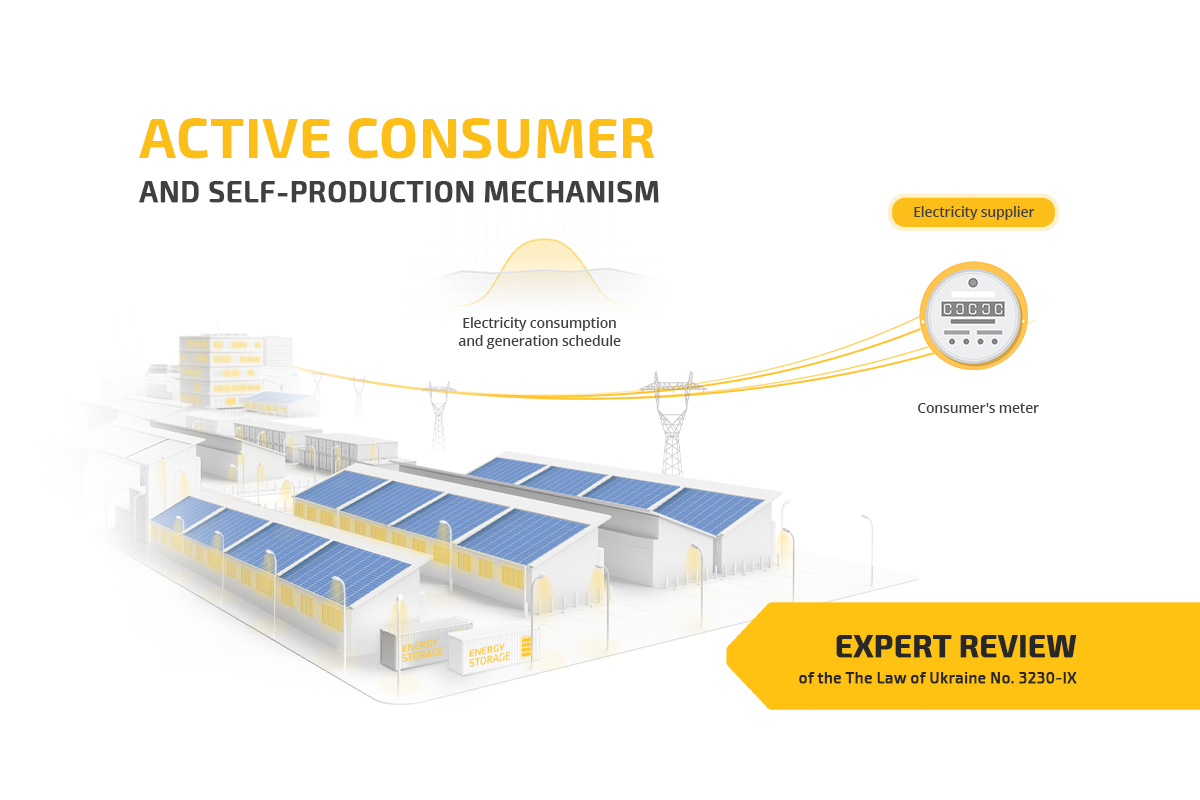
Find out about active consumers and the system of their support, namely the mechanism of self-production, in an expert review by Serhii Kravchuk, Director of Electricity Trading and Supply in KNESS.
The Law of Ukraine No. 3230-IX introduced the concept of “active consumer”.
Active consumer is a consumer, including a private household, an energy cooperative and a consumer who is an energy service customer, which consumes and produces electricity, and/or carries out energy storage activities, and/or sells surplus produced and/or stored electricity, or participates in energy efficiency and demand management activities in accordance with the requirements of the law, provided that these activities are not professional and/or economic activities.
It means a private household, public utilities, energy cooperatives, and businesses can obtain the status of an active consumer.
A consumer acquires the status of an active consumer when:
- concludes a power purchase and sale agreement under the self-production mechanism, which is an annex to the agreement for the electricity supply to the consumer;
or
- concludes an agreement with a guaranteed buyer or all- purpose service provider for the electricity sale under a feed-in tariff.
- installs energy storage systems in order to participate in the ancillary services market, provide balancing services and purchase and sale of electricity used for energy storage in energy storage facilities in organized market segments independently or as part of aggregated groups.
A consumer loses the status of an active one in the following case:
- an active consumer with an installed capacity of generating electrical installations of more than 1 MW loses the status of an active consumer for a calendar year if, in the previous calendar year, the volume of electricity supplied to the grid by the generating electrical installations of the active consumer exceeds 50 percent of the total electricity consumption (from the grid and from the active consumer’s generating electrical installations) of such an active consumer.
- The procedure for revoking the status of an active consumer and the consequences of such revocation are determined by the Regulator.
As we have already mentioned, both household and non-household owners of generating facilities can become active consumers, but with certain restrictions on the installed capacity. In particular for:
+ household consumers in their private households – generating units with an installed capacity not exceeding 50 kW;
+ other consumers, including energy cooperatives – generating units with an installed capacity not exceeding 150 kW;
+ private households – generating units with an installed capacity not exceeding 30 kW (but not more than the capacity allowed for connection);
+small non-household consumers – generating units connected to electrical installations intended for direct consumption of electricity with a capacity not exceeding 50 kW (but not more than the capacity allowed for connection);
+ non-household consumers – generating units connected to electrical installations intended for direct consumption of electricity but not exceeding the capacity allowed for connection.
What are the technical specifics of implementing such generation facilities?
The technical requirements that must be met by an active consumer related to the connection (interconnection) of generating facilities and energy storages of such a consumer are determined by the distribution system code and the transmission system code.
The capacity of the active consumer’s generating facility is determined by the rated capacity of the inverter equipment of such a generating facility (if any), which ensures parallel operation of the generating facility with the power system.
Among other things, the Consumer has the right to connect RES and ESS generating facilities owned by third parties to its own grids.
The installed capacity of each of such electrical installations shall not exceed the permitted capacity of such consumer’s electrical installations deducting the installed capacity of such consumer’s own generating facilities and energy storage facilities, respectively.
At the same time, the entire volume of electricity produced by such RES and ESS generating units is purchased by the consumer.
A support system called a self-production mechanism is also in effect for active consumers.
According to the Law, the self-production mechanism is a support system for active consumers intended for their own electricity consumption, which is used to mutually settle the cost of electricity volumes supplied to the grid by generating units of such consumers and the cost of electricity consumption volumes from the grid, taking into account the cost of electricity transmission and/or distribution services.
In other words, this mechanism enables active consumers to install generation sources with a capacity not exceeding their permitted connection capacity for their own consumption and sell excess electricity to the energy supply company at a market price when the volume of electricity generation exceeds the volume of electricity consumption.
What are the restrictions on electricity supply to external power grids?
The electricity capacity of an active consumer under the self-production mechanism (except for household consumers and small non-household consumers), including generating facilities and energy storage facilities of third parties, allowed to be supplied to the grid, may not simultaneously exceed 50 percent of the permitted (contractual) capacity of the electrical installations of such consumer intended for the electricity consumption.
If such an active consumer meets certain technical requirements of the distribution system operator or the transmission system operator to which the active consumer’s electrical installations are connected, the electricity capacity allowed for supply to the grid may be increased.
What are the specifics of buying and selling “surplus” electricity?
The cost of electricity supplied by an active consumer must be credited to the personal account of such active consumer within the period specified by the rules of the retail electricity market.
According to a self-production electricity purchase and sale agreement, the electricity supplier must offset the cost of electricity generation/consumption as of the first day of the calendar year following the end of the billing period.
If during the billing period (month) the cost of electricity consumed from the grid exceeds the cost of electricity supplied, the difference between the cost of consumed and supplied electricity must be paid by the active consumer in favor of the supplier.
If during the billing period (month) the cost of electricity supplied exceeds the cost of electricity consumed, the difference between the cost of electricity supplied and consumed must be paid by the supplier in favor of the active consumer in the month following the billing period.
What else is important?
Confirmation of the fact and commissioning date of the generating unit of an active consumer (except for the generating installation of a private household or rooftop solar power plants, the installation of which can be carried out without obtaining permits in the construction field) is a certificate issued by the authorized body verifying the compliance of the completed facility with the design documentation and confirming its readiness for operation, or a declaration of readiness for operation registered in accordance with the law, or a declaration of readiness for operation of a facility constructed on the basis of a construction passport.


