



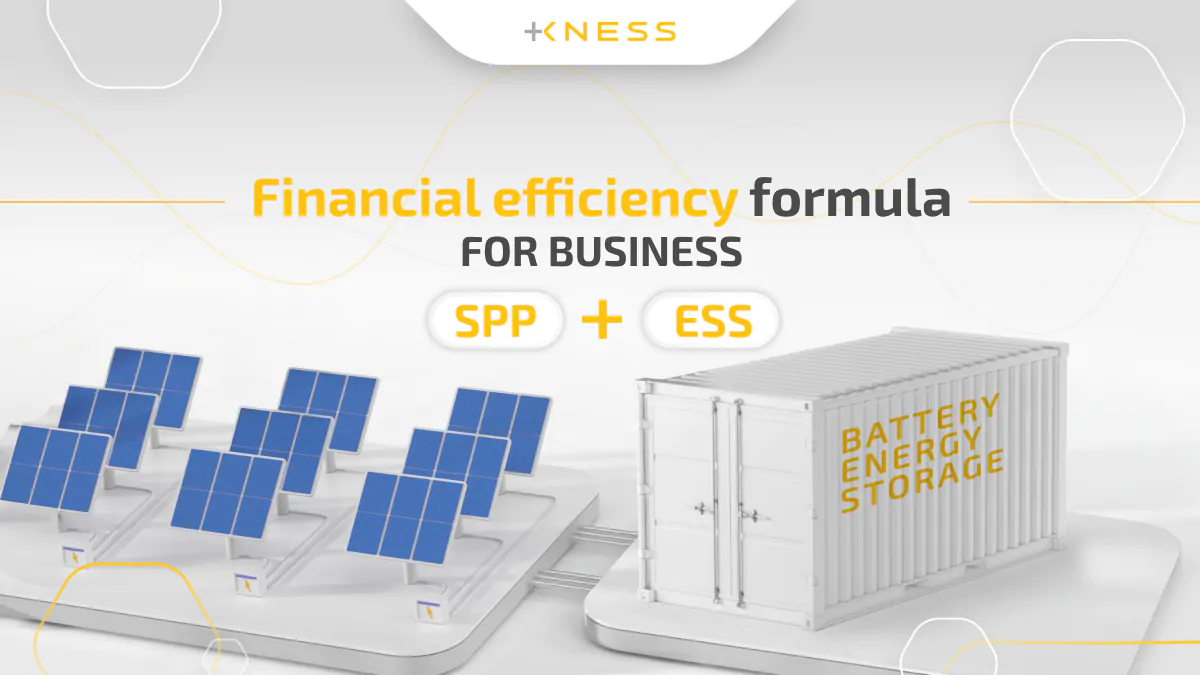
Installing a solar power plant (SPPs) together with an energy storage system (ESS) opens up new opportunities for your business. First and foremost, this is a step towards energy independence for your enterprise and a sustainable source of income.
How does this work in practice?
- Economic context
SPP makes it possible to store excess SPP generation, which can then be used at night or during peak load hours. The installation can also be charged from the grid during low-price hours. This is advantageous given the differentiated tariffs. What are the economic benefits of this model? Take, for example, a company that consumes 1,000 kWh of electricity on weekdays from 9 a.m. to 6 p.m. and 300 kWh at night. After installing a 1.25 MW SPP and a 4.2 MWh ESS, the consumer will cover on average 40-50% of its own electricity needs within a day during the summer. On weekends, when consumption drops to 300 kWh, this percentage can reach 70%. Thus, the company significantly reduces its costs for purchasing electricity from the grid.
- New opportunities: more than just consumption
By installing a power generation facility and energy storage system for own needs, an enterprise can obtain “active consumer” status, which allows it to sell surplus generation to its electricity supplier. This status also opens up the possibility of joining an Aggregated Group, which allows companies to enter the most profitable segment of the market and use electrical installations to provide ancillary services. What is the benefit for business? A systematic income and a reduction in the payback period for energy facilities, on average to 3 years.
- Increasing energy independence
Thanks to the combination of SPP and ESS along with the appropriate inverter equipment, your business can operate in “island” mode. This means that even in the event of power outages from the main grid, the enterprise will be able to continue operating and producing products without disruption.
- Environmental context
Consuming clean energy is not only a contribution to combating climate change, but also an important aspect of shaping a positive image for companies on the international market, as it demonstrates compliance with ESG principles.
What types of businesses benefit most from installing SPP and ESS?
- Enterprises that consume electricity during peak hours when prices are highest and are interested in reducing their electricity costs
- Manufacturers, logistics centers, etc. for whom it is important to have a stable and uninterrupted power supply
- Enterprises with high energy consumption, as a result of which the cost of electricity accounts for a significant share of the cost of their goods or services
- Exporters, businesses that cooperate with international investors, where the environmental component and compliance with the principles of sustainable development are valued
Other business models based on ESS and RES
Currently, certain trends are observed on the market, in particular, electricity shortages in the evening hours and surpluses during the day and night, caused by a sufficiently high level of base (non-maneuverable) generation. There is a clear daily and seasonal volatility in market prices, which is beneficial for ESS operators, who can also operate within the perimeter of RES producers. Therefore, SPP projects in conjunction with ESS are quite attractive for investment.
Today, profitability and return on investment in the implementation of SPP+ESS is better than that of “traditional” SPP construction for operation under an arbitration model. The implementation of 1 MWh of installed ESS capacity is twice as cheap as 1 MW of SPP capacity. At the same time, newly adopted legislative changes allow, in the joint construction of RES and ESS facility, use ESS to transfer energy in time not only from the generation facility but also from the external grid.
Another equally interesting business model is operating in the market of ancillary services. This involves providing frequency containment reserve (FCR) services and automatic frequency restoration reserve (aFRR) services. This is a rather complex and intellectual undertaking, but currently, quite a few businesses, including KNESS with one of the largest project pools, are implementing industrial ESS specifically for the energy system’s reserve needs.
Combining SPP and ESS is a strategic investment that offers a wide range of opportunities.
For enterprises, this means energy independence, optimization of electricity costs, a new source of income, and evidence of environmental responsibility.
For ESS operators, together with RES generation, this means a steady income and contribution to the resilience of Ukraine’s energy system.


