



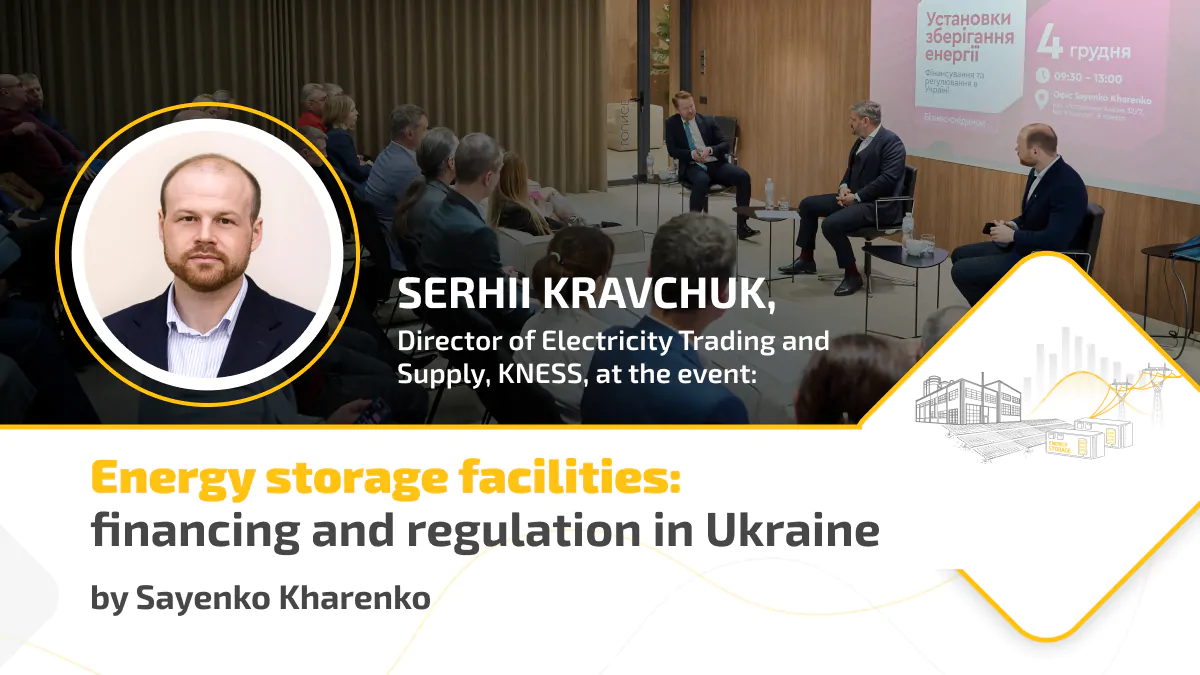
Energy storage systems (ESS) are becoming one of the key elements of the new architecture of the Ukrainian energy system, both in terms of maintaining reliability and the attractiveness of business models. Recently, this topic once again brought together leading players in the energy market, representatives of financial institutions, and state regulators in a professional dialogue at a business breakfast hosted by the Sayenko Kharenko law firm. Serhii Kravchuk, Director of Electricity Trading and Supply in KNESS, also joined the expert discussion on the regulatory and practical aspects of ESS application. The speaker took part in a panel discussion entitled “Regulation for ESS in Ukraine: market challenges and prospects.”
In his speech, Serhii Kravchuk emphasized practical indicators that are critical for investors. In particular, he noted the success of special auctions for the purchase of ancillary services, which were held in the summer of 2024 and early 2025. As a result, the actual price of the frequency containment reserve (FCR) product service decreased by half compared to the pre-auction price. The price of the automatic frequency restoration reserve (aFRRs) service also halved, but only after the third auction.
Another important prerequisite for attracting investment in ESS projects is data transparency on the part of the transmission system operator (TSO):
“To determine the technical characteristics of the equipment that will provide ancillary services, we analyzed statistics on the activation of ancillary service providers based on open data from the official website of the system operator. Based on this, we developed not just a financial model, but a full-fledged business model to attract investments from the bank, since, along with the main financial indicators, it is also important to correctly reflect the activation volumes that affect the electricity consumption/output by the installation in the model. KNESS has already implemented a portfolio of ESS projects with a total capacity of over 100 MWh, and for more than two months we have been providing high-quality ancillary FCR and aFRRs services. Moreover, we already have the opportunity to compare our assumptions with the actual financial results: we are satisfied because our expectations have been met,” emphasized the KNESS expert.
In addition, Serhii Kravchuk focused on the technical aspects of using the ESS resource:
“When selecting equipment for FCR services, we consider it appropriate to focus on the 1P characteristic, while for business price arbitrage strategies, it is necessary to establish a different ratio between power and capacity, which currently stands at 0.25P (i.e., for 1 MW of power, choose 4 MWh of capacity),” explained Serhii Kravchuk.
We would like to thank Sayenko Kharenko law firm for the invitation, meaningful discussion, and opportunity to share KNESS’s practical experience in scaling the energy storage market in Ukraine.


