



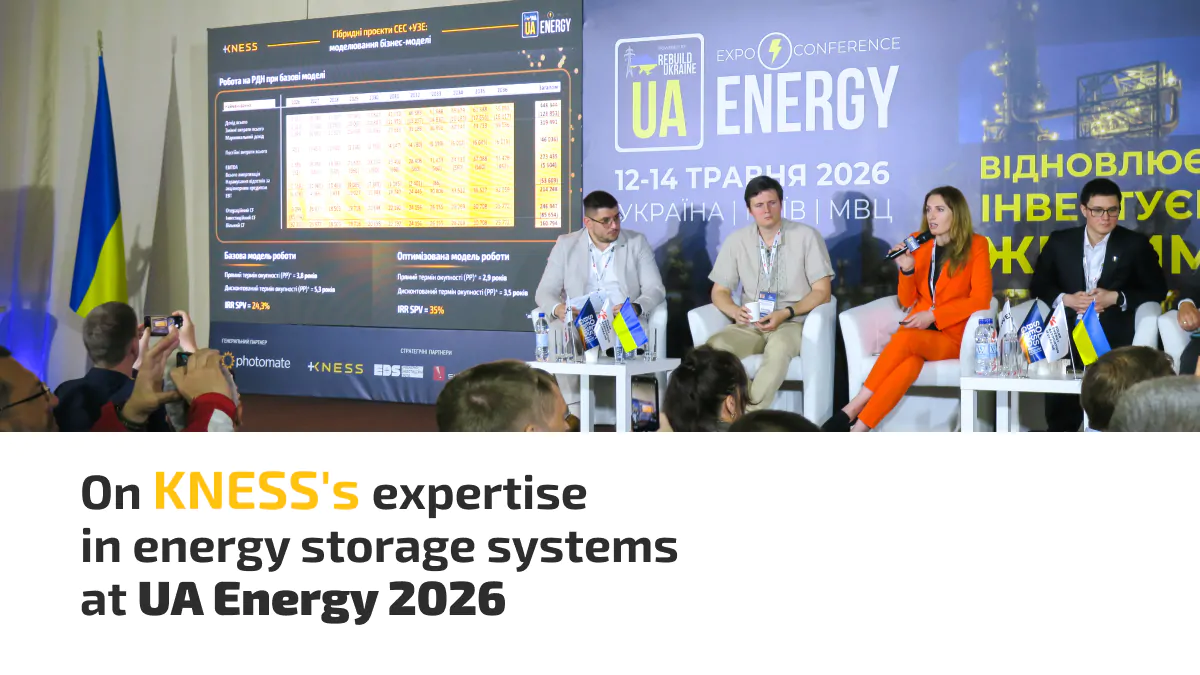
Here we are back from the UA Energy 2026 exhibition and conference. At the event, we met with partners and shared our expertise on the forum stages, where KNESS acted as a strategic partner. Tetiana Petrovska, Commercial Director in KNESS, represented KNESS’s expertise in the discussions. Her speeches focused on the topic of energy storage systems. Below are some of the key points from her forum talks.
UA Energy Vision Day: Scenarios for ESS Deployment in Ukraine and Abroad Based on KNESS’s Experience
During UA Energy Vision Day, Tetiana Petrovska emphasized that there is currently no single, universal business model for energy storage systems. The most effective approach is to use ESS flexibly across different market segments – depending on investor needs, market conditions, and asset management algorithms.
Key takeaways from Tetiana’s speech:
- ESS is a tool whose effectiveness depends on how it is used. The equipment itself does not automatically create value. The outcome depends on the markets in which the facility operates, who manages it, the quality of the analytics, and how quickly the owner can respond to market volatility.
- The arbitrage model in Ukraine is already proving its investment appeal. At the same time, the market remains volatile, so it is important for investors not to rely on a single operational scenario. The most effective approach is the “multi-scenario” use of energy storage systems: deploying ESS across different market segments.
- Today, SPP should be viewed as a fully effective project only when combined with ESS.
Energy storage systems allow for the storage of excess daytime generation, which can then be sold or used during evening peak hours, as well as helping to reduce imbalances of solar power plants.
- For industrial businesses, ESS is no longer just about backup. Companies are shifting from a logic of backup power to creating predictable consumption, protecting against price volatility, and increasing production autonomy and flexibility.
- The automated Energy Management System is the project’s key asset. It is the “brain” of the system that enables the ESS to be used as efficiently as possible in accordance with the owner’s priorities.
In response to the moderator’s question about the possibility of negative electricity prices in Ukraine, Tetiana Petrovska cited the example of the Baltic states, where such prices are already a market reality and are driving the widespread adoption of energy storage systems. Under these conditions, ESSs allow electricity to be stored during periods of low or negative prices and used when prices are higher.
SOLAR BESS GRID Forum: key points on KNESS’s vision for the development of the ESS market
At the SOLAR BESS GRID Forum, Tetiana Petrovska presented KNESS’s vision for the role of energy storage systems (ESS) in shaping a decentralized, flexible, and more independent power grid in Ukraine.
She emphasized that today, the energy sector is about more than just infrastructure. In the Ukrainian context, it is a matter of security, economic efficiency, self-sufficiency, and the ability of businesses and the state to operate in conditions of uncertainty.
“In KNESS, we envision the energy sector of the future as decentralized, flexible, and independent. Energy storage systems are one of the key tools for this transformation. That is why KNESS has been researching energy storage technologies since 2017. And today, we already have about 900 MWh of ESS projects at various stages of implementation. The group’s total pipeline is about 1 GWh,” noted Tetiana.
Tetiana also spoke in more detail about trends in the market for ESS project equipment and emphasized the importance of installers’ expertise.
“Energy storage technologies are advancing very rapidly. Container capacities are increasing, and system efficiency, particularly round-trip efficiency, is improving, which impacts project economics and allows for cost optimization during implementation. However, when implementing projects, the integrator’s experience, references from completed projects, the availability of local service support, a spare parts warehouse in Ukraine, and the ability to implement projects comprehensively and on schedule are equally important.”
We would like to thank the organizers of UA Energy 2026 for providing a platform for professional dialogue, and the forum participants for their substantive discussions, open exchange of experiences, and new connections.
Continuing to work on developing a decentralized, flexible, and independent energy system for Ukraine.


