



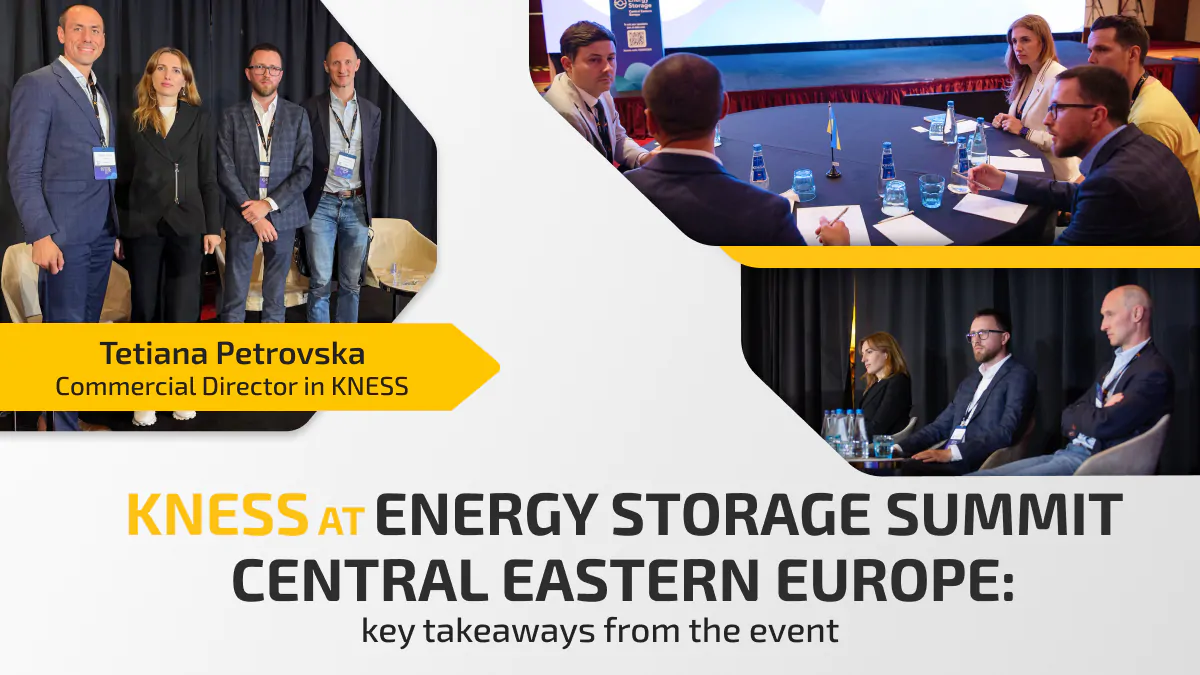
KNESS presented its experience in implementing energy storage projects at the Energy Storage Summit 2025. The event took place in Warsaw, bringing together representatives of the energy community in Central and Eastern Europe. They discussed the challenges and prospects in the field of energy storage, with an emphasis on regional characteristics.
Tetiana Petrovska, Commercial Director in KNESS, shared the key points from the summit:
-
- Today, the energy storage market in Central and Eastern Europe is undergoing a period of profound transformation — from pilot projects to systemic strategies. Poland, as one of the leaders in the region, is demonstrating ambitious goals. According to one of the speakers, by 2035, the country plans to build more than 18 GW of energy storage facilities, and state investments in energy storage will reach PLN 14 billion. It is worth noting that over 600 applications for 20.6 GW of projects have been submitted only within the framework of national grant programs.
- A key trend that is clearly evident is the changing role of ESS: from a reserve capacity element to a full-fledged participant in the ancillary services market. This is where the new flexibility economy is taking shape—with capacity mechanisms, auctions for FCR / aFRR, long-term contracts, and the possibility of generating stable income for investors.
- Technologically, the market is also evolving: solutions with high DC-AC efficiency, integrated fire safety systems, modular cabinet ESS for rapid deployment are being introduced, and new EMS solutions for capacity aggregation are being developed.
- There is definitely interest in cooperation with Ukraine. European companies see Ukraine as a market that is facing the same challenges, but in a short time frame, and has its own advantages — a high technical level, speed of decision-making, and readiness to implement new partnership formats.
Also, Tetiana Petrovska participated as a speaker in a panel discussion dedicated to Ukraine’s resilience and reconstruction. The conversation covered the practical steps for developing energy storage infrastructure in Ukraine, investment mechanisms, the regulatory environment, and the principles of the ancillary services market.
“It is important for us not only to follow trends, but also to set new ones in the region. Today, KNESS has practical experience in implementing energy storage facilities in Ukraine, engineering expertise that meets European requirements, and a readiness to integrate into the common energy ecosystem of Europe. This summit has once again confirmed that the development of the future energy sector is only possible through partnership and synergy between countries in the region,” Tetiana emphasized in her report.
We would like to thank the organizers of the Energy Storage Summit for providing a platform where the international partnership can be strengthened and best practices in the field of energy storage can be shared.


